Books

The Social Order
The Social Order is a translation of French economist Jacques Rueff's most important work.
Originally published in French in 1945 as L'Ordre Social, this translation takes up the 1981 edition of the book, which includes the preface to the third edition.
Rueff posits that an important distinction exists between true and false rights, and analyzes the relationship that exists between the deficit and inflation, among other important economic phenomena, on this basis.
The book retains an enduring significance. In this multi-faceted work, Rueff grapples with the close connection that exists between social and economic order, and recommends policy measures likely to foster an ordered freedom.
Beyond his debates and disagreements with John Maynard Keynes, Rueff is best-known for being the architect of France's successful 1958 economic reform package. He also advised multiple French governments before the war.
This translation project was made possible thanks to the support of Liberty Fund and the permission of the Rueff family.
Both a paperback ($14.50) and hardcover ($24.00) version of the book are available from October 28th onward at Amazon and Liberty Fund.
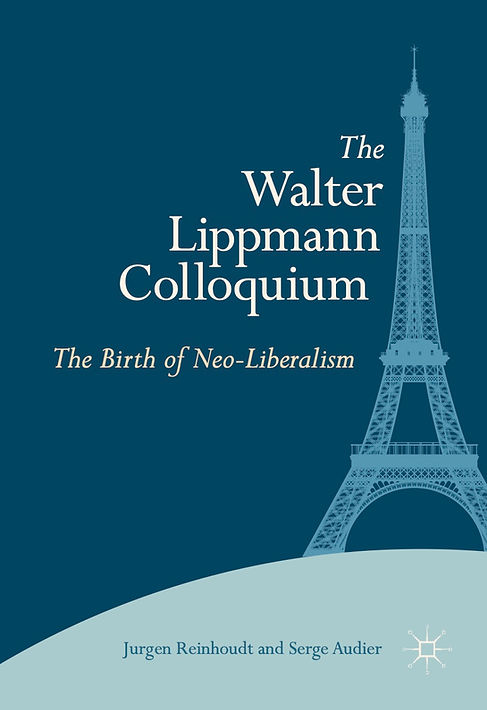
The Walter Lippmann Colloquium: the Birth of Neo-Liberalism
This book is an introduction to, and translation of, the 1938 Walter Lippmann Colloquium held in Paris, which became known the intellectual birthplace of “neo-liberalism.” The Lippmann Colloquium marks an important chapter in the history of economic ideas, particularly that of economic liberalism (in the classical and European sense of the term).
Although the Lippmann Colloquium has been the subject of significant recent interest, this book makes this crucial primary source available to a wide, English-speaking audience for the first time. The Colloquium featured important—often passionate—debates involving well-known intellectual figures such as Walter Lippmann, Louis Rougier, Friedrich Hayek, Ludwig von Mises, Michael Polanyi, Jacques Rueff, Alexander Rüstow and Wilhelm Röpke.
The Colloquium is not only of historical importance, as many of the topics addressed at the Colloquium, such as the proper methods of economic intervention, the relationship between the market economy and democracy, and the relationship between economic liberalism and political liberalism are issues that still vie for our attention in the aftermath of the Great Recession.
The book was published as an academic book by Springer/Palgrave Macmillan. The book is accessible for free through any library that has a subscription to SpringerLink (typically a university library). The book is also available for purchase through Amazon and Barnes & Noble. My co-author and collaborator in this project was Serge Audier.

Neoliberalismus, Wie alles anfing: Das Walter Lippmann Kolloquium
This book is a German translation of the 1938 Walter Lippmann Colloquium. The German edition was published by Kursbuch Editions thanks to a grant provided by the Brougier-Seisser-Cleve-Werhahn-Stiftung. The German translation was provided by Michael Hein.
The price of this edition is designed to make the book broadly accessible to a German-reading audience.
A digital and print copy of the book can be purchased here.